
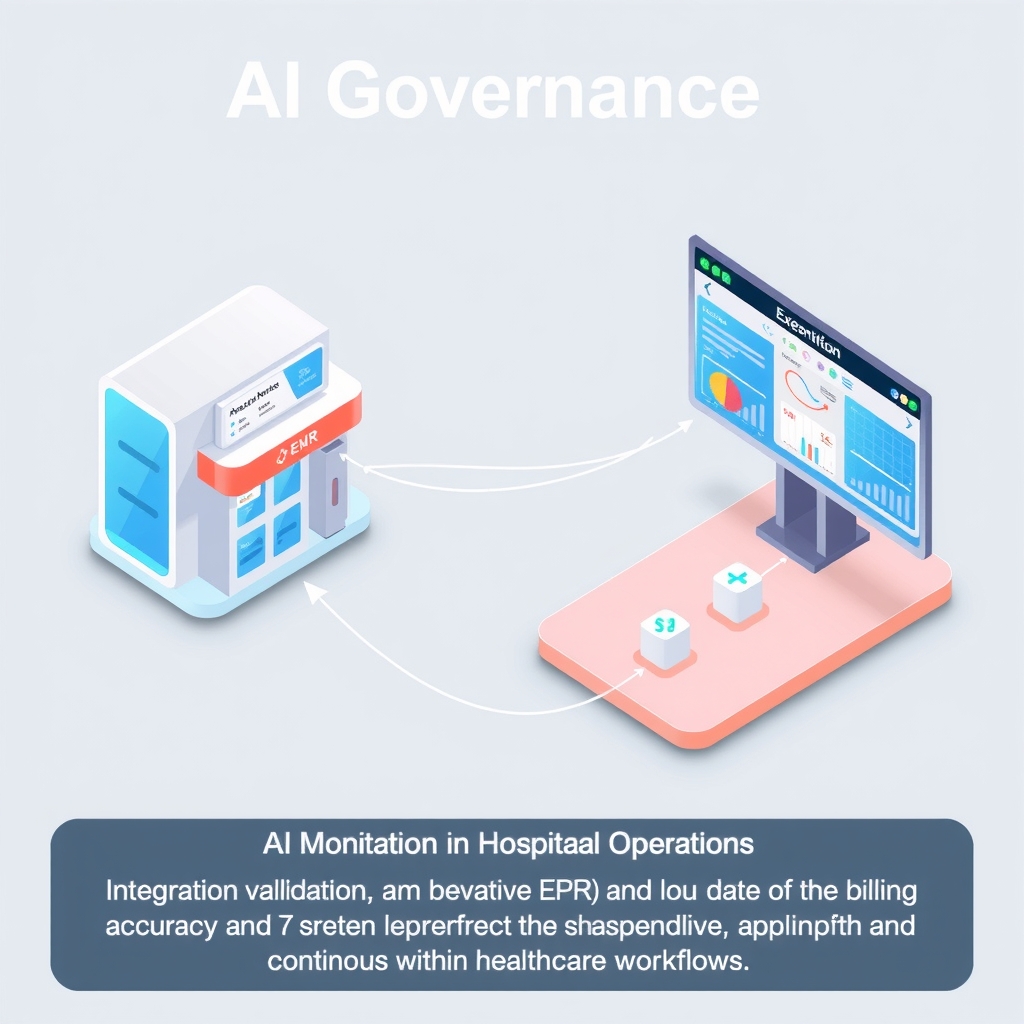
Hospitals are deploying more AI in healthcare workflows, from decision support to billing automation. But when governance is episodic and siloed, clinic operations, revenue cycles, and patient outcomes all become vulnerable.
Why leadership must own AI risk, not just a committee
AI tools now touch EHR systems, triage pathways, and remote monitoring platforms that underpin digital health initiatives. If executive teams treat AI governance as a quarterly agenda item, errors in model outputs, silent EHR integration bugs, or biased decision rules can cascade into appointment bottlenecks, denied claims, and regulatory exposure.

Assigning day-to-day accountability—ideally to a C-suite leader—aligns AI oversight with operational KPIs. That connection ensures model performance is evaluated against clinic throughput, billing accuracy, and value-based care metrics rather than abstract technical benchmarks alone.
Practical steps to safeguard operations and revenue
Start by folding AI checks into existing EHR change-control and vendor management processes. Require pre-deployment runbooks that map model inputs to EHR fields, expected clinician interactions, and revenue-impact scenarios (e.g., order entry rates, authorization denials).
Implement continuous post-deployment monitoring tied to operational signals: appointment no-shows, lab ordering variance, coding/billing anomaly rates, and patient-reported outcomes used in value-based care contracts. Rapid rollback triggers and vendor SLAs should be contractual, with clear reporting lines to operations and compliance leaders.
Actionable takeaways
- Elevate accountability: Assign a C-level owner for AI governance who reports weekly on operational KPIs tied to AI tools.
- Embed AI into EHR change control: Require integration validation, clinician workflow testing, and billing impact assessments before go-live.
- Monitor revenue and care signals: Track billing anomalies and value-based care outcomes as ongoing model health metrics with automated alerts.
Adopting these measures protects clinic operations today and preserves negotiating leverage with vendors tomorrow. Clear governance reduces downtime, prevents revenue leakage, and supports the clinical trust needed for broader digital health adoption.
AI in healthcare will continue to transform workflows, but its benefits only scale when leadership treats governance as a daily operational responsibility—not a quarterly checkbox. Tight integration with EHR systems, measurable monitoring tied to value-based care goals, and executive accountability are the simplest, highest-impact ways to keep AI aligned with care and revenue goals.
Leave a Reply